Student Interest Is Shifting From Computer Science & AI Toward Engineering, Nova Learning Data Shows
Nova Learning data: student interest in Computer Science & AI fell from 42.3% to 27.9% in 2026, while Engineering interest nearly doubled to 23.0%.
New survey data from Nova Learning shows one of the clearest shifts in secondary student academic interest in recent years: Computer Science and AI, once the dominant choice among students in Nova Learning's network, is losing ground fast, while Engineering has nearly doubled its share.
The topline numbers
Nova Learning surveyed 463 students in 2025 and 677 students in 2026, recording each student's stated primary academic interest through interest forms distributed by Nova Learning. Engineering was the single largest area of growth, adding 11.1 percentage points, more than any other category gained.
Graph 1: Student academic interest by category, 2025 vs 2026
Inside the Engineering surge
The growth wasn't spread evenly across engineering disciplines. It was concentrated in two.
Table 1: Student selection 2025 vs 2026 in engineering disciplines.
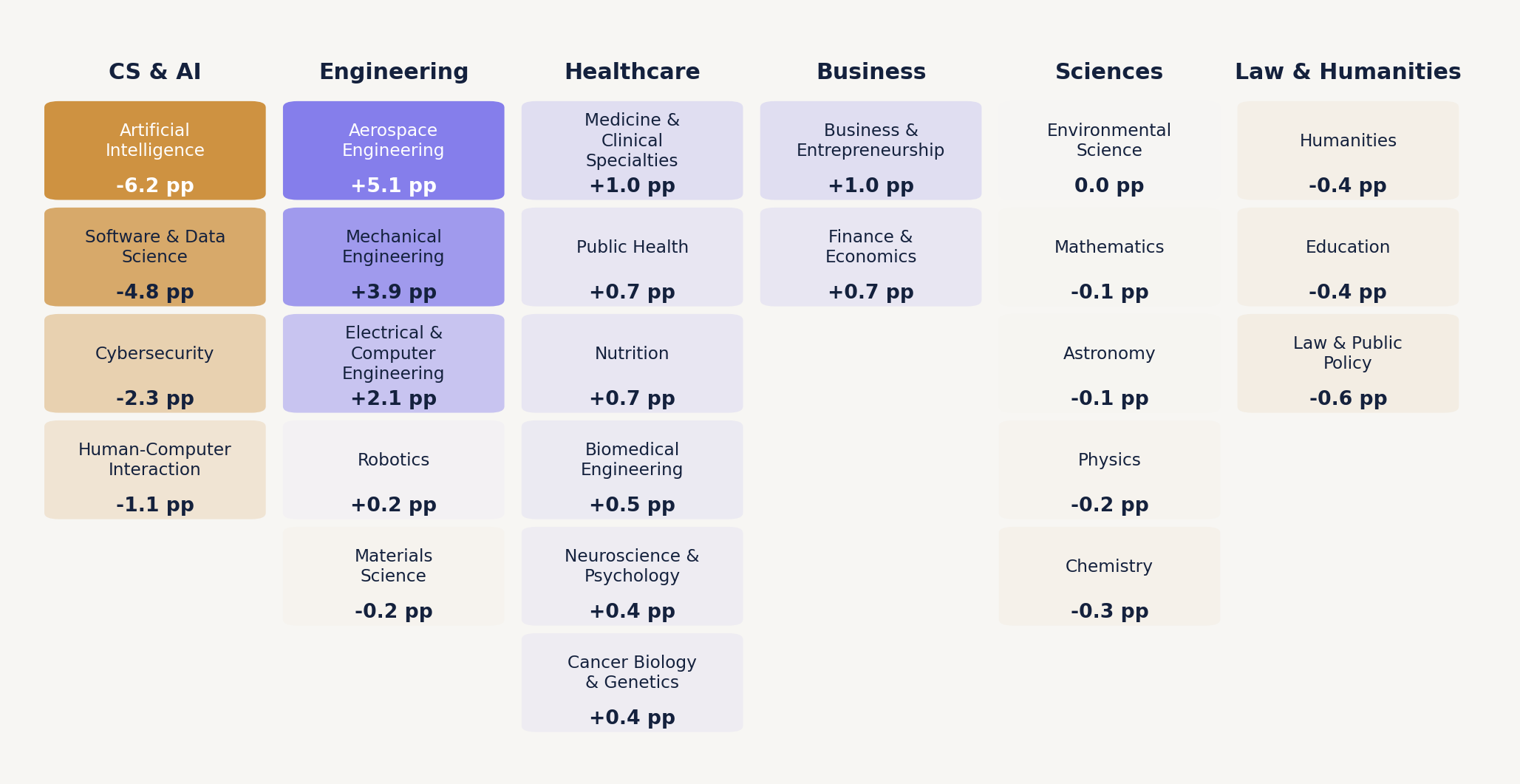
Aerospace and Mechanical Engineering together accounted for more than 60% of students choosing Engineering in 2026 and drove 81% of the category's growth. Electrical & Computer Engineering also grew, adding 2.1 points, while Robotics and Materials Science grew in raw numbers but shrank as a share of the category. The new wave of engineering-interested students is concentrated in Aerospace and Mechanical specifically, rather than spread across the category.
The nuance inside Computer Science & AI
The pullback from Computer Science and AI wasn't uniform either.
Table 2: Student selection 2025 vs 2026 in Computer Science & AI disciplines.
Within the category, Cybersecurity and Human-Computer Interaction held up best. The steepest proportional decline is in Software & Data Science, the most traditional "learn to code" pathway, which lost 44% of its 2025 share. AI saw the largest absolute drop of any single subject in the survey, down 6.2 points. The category did not decline uniformly. Students moved away fastest from the pathway most associated with entry-level software work, while the more applied and human-facing subfields held their ground better.
Where else interest is moving
Healthcare and Business both gained share. Sciences and Law & Humanities saw smaller declines.
Healthcare (21.2% → 24.8%) grew across every subject, led by Medicine & Clinical Specialties.
Business (13.6% → 15.2%) grew proportionally in both its subjects, Business & Entrepreneurship and Finance & Economics, keeping roughly the same 60/40 split.
Sciences (5.2% → 4.6%) and Law & Humanities (5.8% → 4.4%) grew in raw numbers but declined as a share of the sample, since the total respondents were larger in 2026.
Graph 2: Graph 2: Change in each subject's share of students surveyed, 2025 to 2026, in percentage points, grouped by category. Several subjects grew in student numbers while declining as a share, since the 2026 sample was larger. Figures may not sum to category totals due to rounding.
The broader picture
The pattern isn't unique to Nova Learning's network. The National Student Clearinghouse Research Center's Clearinghouse Enrollment Insights: Final Fall Enrollment Trends report, published January 15, 2026, found that undergraduate enrollment in Computer and Information Science programs fell 8.1% at four-year institutions in fall 2025, down to roughly 606,000 students, with declines across award levels and institution types nationally.
The subfield-level data point the same direction.
Cybersecurity and Human-Computer Interaction, both closer to applied, physical, or human-facing problems than general software development, held up better than Software & Data Science, the subfield most associated with entry-level coding work. The data does not suggest that students are moving away from technical fields altogether. Rather, their interests appear to be changing within them. Engineering saw the biggest increase, concentrated in Aerospace and Mechanical Engineering, while Computer Science & AI declined across all four of its subjects.
The timing is notable. Students are seeing headlines about layoffs across the tech industry while hardware, aerospace and other physical technologies attract growing investment. The survey does not tell us whether those trends are influencing students directly, but they provide a possible backdrop for the shift we are seeing.
Methodology
Nova Learning surveyed 463 students in 2025 and 677 students in 2026, recording each student's primary academic interest through interest forms distributed by Nova Learning. Students selected one primary interest from 25 subject areas across six categories:
Healthcare: Medicine & Clinical Specialties, Neuroscience & Psychology, Cancer Biology & Genetics, Public Health, Nutrition, Biomedical Engineering
Business: Business & Entrepreneurship, Finance & Economics
Law & Humanities: Law & Public Policy, Humanities, Education
The sample consists primarily of middle and high school students from the U.S. West Coast and was not designed to be nationally representative.
A methodological note
The 2025 and 2026 cohorts are two separate groups of students. No individual student appears in both years. These results describe a difference in the composition of two cohorts, not a change in any individual student's preferences over time. They should be read as a shift in what a new group of students is choosing, not as evidence that students are switching interests mid-journey.
About Nova Learning
Nova Learning is a white-label platform for academic mentorship. Education companies run research, enrichment and test-prep programs under their own brands on Nova Learning's mentor network, curriculum and program operations software. Founded in 2024, Nova Learning has served thousands of students through partner organizations in more than 15 countries, supported by a network of more than 450 mentors. For more information, visit novalearninggroup.org.


.png)
.png)
.png)
.webp)